Hyderabad, 16 July
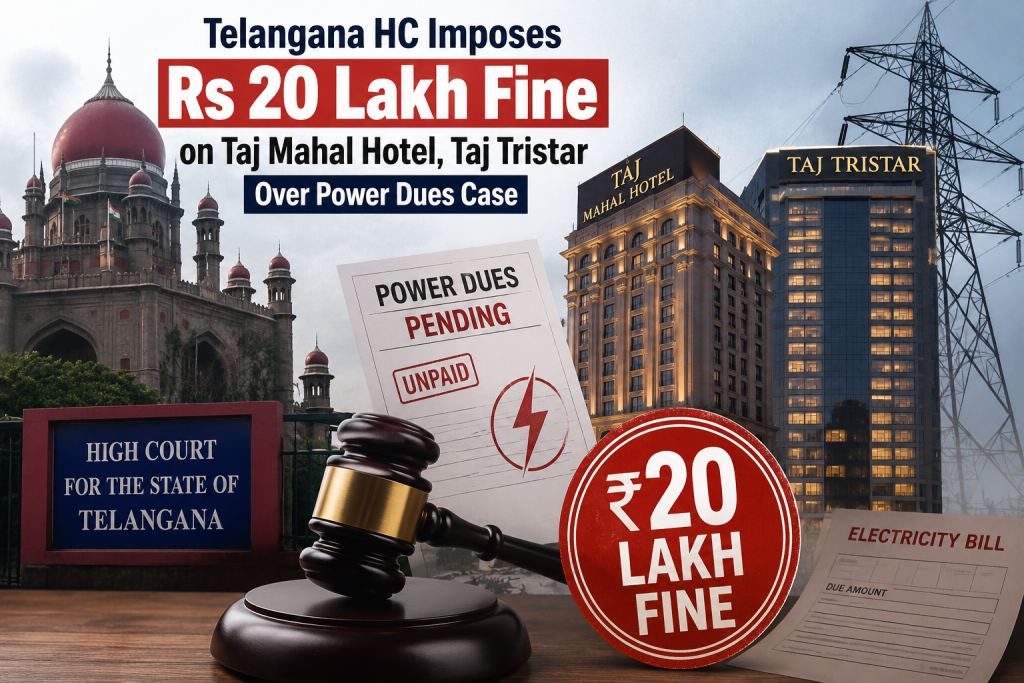
Telangana HC Imposes Rs 20 Lakh Fine on Taj Mahal Hotel, Taj Tristar Over Power Dues Case
The Telangana HC Imposes Rs 20 Lakh Fine on two well-known hotel operators after dismissing their writ petitions challenging power surcharge demands. In a significant ruling delivered on Wednesday, July 15, the High Court imposed an exemplary penalty of Rs 10 lakh each on Taj Mahal Hotel, Abids, and Hotel Taj Tristar, Secunderabad, observing that both petitioners had approached the court with “unclean hands.”
Justice Nagesh Bheemapaka passed the order while hearing petitions filed by B Sundar Rao Hotels, which operates Taj Mahal Hotel at Abids, and Sundar Taj Mahal Hotels, which runs Hotel Taj Tristar in Secunderabad. The court also directed that the total fine of Rs 20 lakh be deposited with the Telangana State Legal Services Authority.
Hotels Challenged Cross-Subsidy Surcharge Demands; Telangana HC Imposes Rs 20 Lakh Fine on Taj Mahal Hotel, Taj Tristar Over Power Dues Case
The dispute arose after the Telangana State Southern Power Distribution Company (TGSPDCL) issued cross-subsidy surcharge (CSS) demand notices to both hotel operators.
According to court records, B Sundar Rao Hotels challenged a CSS demand of Rs 27.5 lakh, while Sundar Taj Mahal Hotels questioned a demand of Rs 77.7 lakh. The demands related to electricity charges for the period between 2005-06 and 2014-15.
The petitioners argued that they had procured electricity from Rain Calcining, an authorised power generator under the Electricity (Supply) Act, 1948. They claimed that this made them eligible for exemption from paying the cross-subsidy surcharge under the Electricity (Removal of Difficulties) Second Order, 2005.
To strengthen their case, the hotels relied on earlier judgments of the High Court, including the Rain Cements case, where similar CSS demand notices had been set aside.
TGSPDCL Opposed the Fresh Petitions
Opposing the pleas, TGSPDCL argued that the petitions were not maintainable because they had been filed against individual officials rather than the power distribution company itself.
Appearing for TGSPDCL, standing counsel N. Sreedhar Reddy informed the court that both hotels had previously challenged the same demand notices. However, those petitions were later withdrawn without obtaining permission to file fresh petitions on the same issue.
The counsel further pointed out that after withdrawing the earlier cases, both hotel operators had approached the electricity authorities seeking instalment facilities to pay the outstanding dues. He also argued that the provisions of the Electricity (Removal of Difficulties) Second Order, 2005, were not applicable to the petitioners and cited Supreme Court judgments in support of the company’s stand.
High Court Finds Suppression of Material Facts
While delivering the verdict, the court accepted the objections raised by TGSPDCL and ruled that the fresh writ petitions were not legally maintainable because the earlier petitions had been withdrawn without liberty to refile them.
The High Court further observed that the petitioners had suppressed important facts, including their requests for instalment payments and partial settlement of the dues. Justice Nagesh Bheemapaka held that such suppression amounted to approaching the court with “unclean hands,” a principle under which litigants are expected to disclose all relevant facts honestly.
Taking serious note of the conduct of the petitioners, the court dismissed both writ petitions and imposed an exemplary cost of Rs 10 lakh each, bringing the total penalty to Rs 20 lakh.
Court Sends Strong Message
The ruling underscores the judiciary’s emphasis on transparency and good faith in legal proceedings. By imposing substantial costs on the petitioners, the High Court reinforced that parties seeking judicial relief must make full and truthful disclosures before the court.
The Telangana HC Imposes Rs 20 Lakh Fine judgment is expected to serve as a reminder that suppressing material facts or attempting to re-litigate matters without proper legal grounds can invite strict judicial action and financial penalties.