New Delhi, 31 July
Supreme Court Seeks Centre’s Reply on Plea to End Polygamy Among Muslims
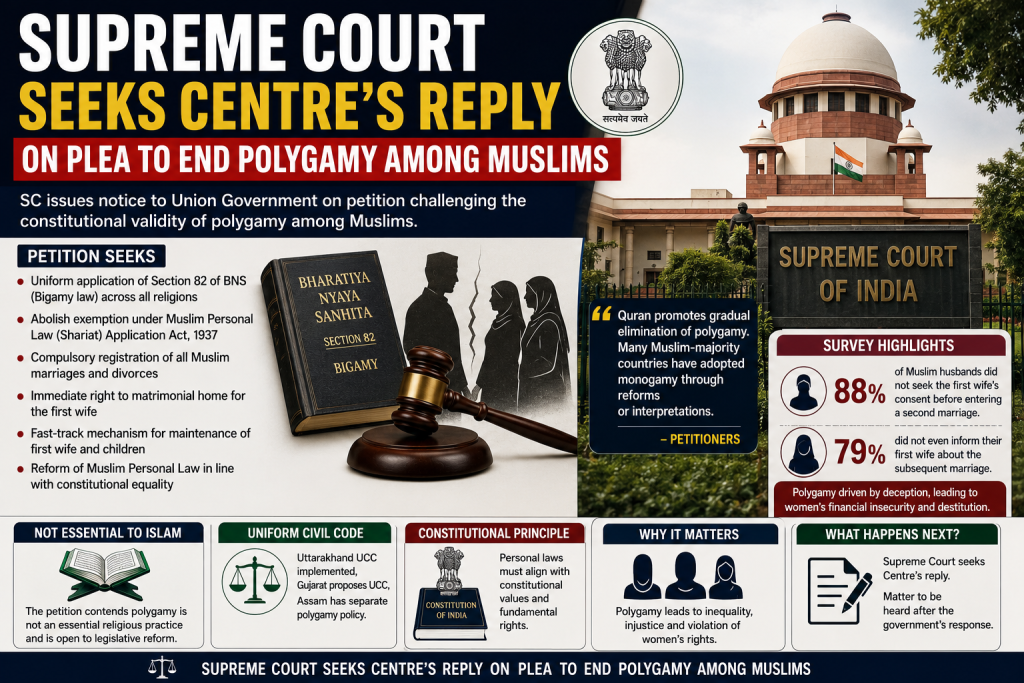
The Supreme Court Seeks Centre’s Reply on Plea to End Polygamy Among Muslims after issuing a notice to the Union government on a petition challenging the constitutional validity of the practice. The petition also seeks a direction to Parliament to abolish polygamy for all citizens, irrespective of religion.
A Bench headed by Chief Justice of India (CJI) Surya Kant issued the notice on Friday, July 31, while hearing a petition filed by activist Zakia Soman and others.
Petition Seeks Uniform Application of Bigamy Law
The Supreme Court Seeks Centre’s Reply on Plea to End Polygamy Among Muslims as the petition urges the court to apply Section 82 of the Bharatiya Nyaya Sanhita (BNS) uniformly across all religions.
The petition argues that while bigamy is punishable under Indian law for Hindus, Christians and Parsis, Muslim men continue to enjoy an exemption under the Muslim Personal Law (Shariat) Application Act, 1937, which permits up to four wives.
The petitioners requested the court to remove this exemption in the interest of equality before the law.
Mandatory Registration of Muslim Marriages Proposed
The plea also seeks compulsory registration of all Muslim marriages and divorces with state authorities.
According to the petitioners, mandatory registration would help prevent secret second marriages and protect the rights of women.
The Supreme Court Seeks Centre’s Reply on Plea to End Polygamy Among Muslims while the petition also demands an immediate right to the matrimonial home for the first wife and a fast-track mechanism for maintenance of the first wife and children in cases involving polygamous marriages.
Petition Calls for Reform of Muslim Personal Law
The petitioners have also requested the Supreme Court to direct the Law Commission or the Union government to prepare a draft law codifying Muslim personal law relating to marriage, divorce and succession in accordance with the constitutional principle of gender equality.
They argued that personal laws should remain consistent with constitutional values and fundamental rights.
Petition Says Polygamy Is Not Essential to Islam
The petition contends that the Quran promotes the gradual elimination of polygamy and that many Muslim-majority countries have already adopted monogamy through legal reforms or interpretations of Islamic principles.
According to the petitioners, this demonstrates that polygamy is not an essential religious practice and is therefore open to legislative reform.
The Supreme Court Seeks Centre’s Reply on Plea to End Polygamy Among Muslims after these constitutional arguments were placed before the Bench.
Survey Highlights Lack of Consent in Second Marriages
Referring to a survey conducted last year across Maharashtra, Gujarat, West Bengal, Karnataka, Tamil Nadu, Delhi and Rajasthan, the petition states that:
- 88% of Muslim husbands did not seek the first wife’s consent before entering a second marriage.
- 79% did not even inform their first wife about the subsequent marriage.
The petitioners argued that many such marriages are driven by deception rather than religious necessity and claimed that polygamy has become a major contributor to women’s financial insecurity and destitution.
Uniform Civil Code Also Mentioned
The petition also referred to Uttarakhand’s implementation of the Uniform Civil Code (UCC), Gujarat’s proposed adoption of the UCC, and Assam’s separate policy on polygamy to argue that legal reforms in personal laws are practical and achievable.
The Supreme Court Seeks Centre’s Reply on Plea to End Polygamy Among Muslims as the matter now awaits the Union government’s response before further hearings.