New Delhi, 28 July
Supreme Court Orders Release of Minor Student Protesters, Those With Clean Records
The Supreme Court on Tuesday, July 28, directed all states to release student protesters who are below 18 years of age and those without any criminal antecedents, while observing that the law must take its course whenever there is a violation of the “defined protocol.” Supreme Court Orders Release of Minor Student Protesters.
The apex court also indicated that a Special Investigation Team (SIT) may be constituted to ensure a fair, transparent and independent probe into allegations of violence and police excesses during the recent nationwide student protests over the alleged NEET paper leak.
Supreme Court Seeks Fair Probe Into Protest Violence
A bench headed by Chief Justice of India Surya Kant, along with Justices Joymalya Bagchi and V. Mohana, heard a batch of petitions alleging police excesses against students participating in the protests.
At the outset, the bench questioned whether an independent investigation should be ordered into the incidents.
“Whosoever committed excesses, took law into their hands should be taken to task,” the Chief Justice observed during the hearing.
Taking note of submissions made by lawyers, the bench said all allegations of police excesses required a fair and impartial investigation.
The court further observed that once there is a violation of the defined protocol, the law must take its own course. Supreme Court Orders Release of Minor Student Protesters
No Coercive Action Against Students With Clean Records
During the hearing, the Supreme Court directed that while investigations into the FIRs may continue, no coercive action should be taken against protesting students who have no criminal background.
However, the protection will not extend to individuals with criminal antecedents, the bench clarified.
The court also directed police authorities across all states to preserve digital data collected during the protests and ensure that it is not released into the public domain.
Additionally, it ordered the immediate release of all protesting students who are minors and those without any previous criminal record. Supreme Court Orders Release of Minor Student Protesters.
SIT May Be Formed
The bench said it was considering the constitution of an independent Special Investigation Team (SIT) to thoroughly examine allegations of police excesses as well as incidents of violence during the protests.
The court observed that the proposed investigation should also determine how nearly 250 police personnel sustained injuries and whether those responsible were student protesters or outside miscreants.
Centre Says Miscreants Were Involved
Appearing for the Centre, Solicitor General Tushar Mehta submitted that students were unlikely to have carried out violent attacks on police personnel.
He argued that individuals with criminal backgrounds, including those allegedly involved in murder, rape and offences under the Narcotic Drugs and Psychotropic Substances (NDPS) Act, had infiltrated the protests and were responsible for the violence. Supreme Court Orders Release of Minor Student Protesters
Supreme Court Reaffirms Right to Peaceful Protest
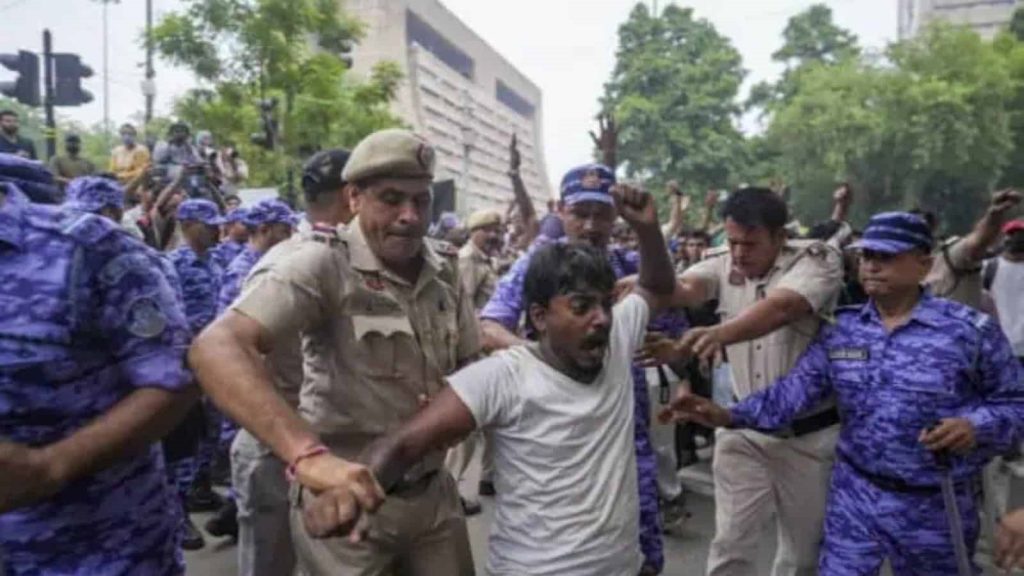
During an earlier hearing on Monday, the Supreme Court had observed that the constitutional right to peaceful protest cannot justify police excesses or lathi charges.
The bench reiterated that peaceful demonstrations remain a fundamental democratic right while stressing that both protesters and law enforcement agencies must act within the framework of the law. Supreme Court Orders Release of Minor Student Protesters
RAF Used Non-Lethal Crowd Control Measures
Meanwhile, officials said the Rapid Action Force (RAF) used multiple non-lethal crowd-control measures while handling protesters during the July 20 ‘Sansad Chalo’ march near Jantar Mantar in New Delhi. Supreme Court Orders Release of Minor Student Protesters
According to official records, the RAF fired:
- 55 non-electrical shells
- 15 electrical shells
- Five tear smoke grenades
- Two rounds from anti-riot guns
- Two rounds of non-lethal plastic pellets
Officials clarified that the plastic pellets were designed for crowd control and are different from metal pellets, stating that they are intended to minimise serious injuries.
The July 20 march, organised by the Cockroach Janta Party (CJP), witnessed clashes after protesters attempted to move towards Parliament, prompting security personnel to use lathis and tear gas to disperse the crowd. Supreme Court Orders Release of Minor Student Protesters
The Supreme Court is expected to continue hearing the matter as it considers the demand for an independent investigation into both the alleged police excesses and the violence that occurred during the protests.